🔥 Exciting News: We partner with Insens to provide advanced solutions for rotating equipment reliability and energy management. Learn More
Bearing Faults
Monitor bearing health without physically adhering devices on the shaft
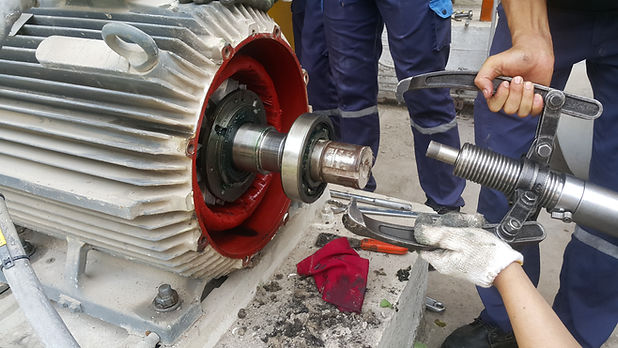
Catching Bearing Failures Early: How Reliability AI Detects Hidden Faults Months in Advance
In rotating equipment, bearings quietly carry the load — literally and figuratively. They keep shafts aligned, reduce friction, and ensure smooth operation of everything from fans and pumps to compressors and conveyors. But when bearings begin to fail, the consequences ripple across the entire system. Vibrations increase, efficiency drops, and in worst cases, catastrophic damage can occur.
Reliability AI offers a breakthrough approach to detecting these problems months before traditional monitoring systems even register a warning — by listening to the magnetic “fingerprint” of the machine itself.

Understanding Bearing Fault Frequencies
Each bearing has unique fault frequencies that serve as early indicators of damage. These frequencies appear when specific parts of the bearing — such as the cage, balls, or races — begin to degrade. Here are the four most critical ones:
-
FTF (Fundamental Train Frequency):
The rotation rate of the bearing cage or retainer. Anomalies here often point to lubrication issues or cage damage. -
BSF (Ball Spin Frequency):
The speed at which the individual rolling elements (balls) spin. A rising BSF can indicate pitting, spalling, or debris on the ball surfaces. -
BPFI (Ball Pass Frequency – Inner Race):
The rate at which rolling elements contact a defect on the inner race. Faults here often worsen quickly because the inner race rotates at shaft speed. -
BPFO (Ball Pass Frequency – Outer Race):
The frequency generated when rolling elements pass over a defect on the stationary outer race. Common in heavily loaded bearings or those with misalignment.
Each of these frequencies provides a kind of mechanical “signature” that can be detected using vibration sensors or advanced electrical monitoring methods.
How Bearing Faults Affect the Motor

When a bearing defect develops, the resulting vibration doesn’t stay isolated. Those vibrations propagate through the shaft and housing, eventually disturbing the air gap flux inside the motor. The motor’s magnetic field begins to fluctuate slightly, altering the waveform of both voltage and current.
These electromagnetic disturbances are incredibly small — far below what a human or even most sensors can perceive. But they are consistent, traceable, and diagnostic.
Why This Matters for Maintenance Teams
Instead of relying solely on vibration sensors installed on each piece of equipment, Reliability AI captures these subtle magnetic signatures indirectly through the voltage and current transformers in the Motor Control Center (MCC).
By continuously analyzing this data, Reliability AI identifies the unique harmonic patterns associated with bearing fault frequencies like FTF, BSF, BPFI, and BPFO. This enables the system to:
-
Detect developing bearing issues months before mechanical symptoms appear
-
Pinpoint whether the fault is on the inner or outer race, or within the rolling elements
-
Monitor all motors in a facility from a centralized location — no extra sensors required
-
Correlate bearing degradation with load, speed, and operating conditions to predict failure timing
What makes this approach powerful is its non-intrusive nature. There’s no need to retrofit sensors or interrupt production. Reliability AI translates electromagnetic noise into actionable insights — turning complex current signatures into a clear picture of equipment health.
By detecting bearing wear months in advance, maintenance teams can plan repairs during scheduled downtime rather than reacting to costly unexpected failures.
The Future of Reliability.
Bearings may be small components, but their health dictates the reliability of entire systems. Traditional vibration analysis still has its place, but Reliability AI’s approach adds a new dimension — using electrical signal intelligence to sense early-stage degradation invisible to other methods.
When you can see bearing faults coming long before they happen, reliability stops being reactive and becomes predictive.